History
Tyrone ‘The Cyclone’s’ ride to the top.
By Liam Daly
Tyrone ‘The Cyclone’ Tongia burst into the Australian professional boxing ranks in 2006 with a show-stopping knockout of Jason Cortis. Michael Schiavello and Paul Briggs labelled the debut one of the most impressive they’d seen and fans across the country took note. Now, four years on, Tyrone holds the Australian Junior Middleweight title; and proves that things rarely come straight forward but persistence pays off...
Tyrone is a proud Australian with strong Papuan New Guinean roots. His mother hails from New Ireland Province in PNG with mixed Cantonese and Austrian decent. His father is a proud Motuan, of the Poreporena Village in Port Moresby PNG with mixed Niuean and Scottish decent.
Tyrone grew up in Logan, south of Brisbane. He attributes his character to a genuine Australian/Cross-Cultural way of life. A brother of 5, Tyrone schooled at Harris Fields Primary, Mabel Park High and graduated at Brisbane State High School.
After starring in both Rugby League and Union at the schoolboy level, making Queensland sides alongside Cameron Smith and Peter Hynes whilst also captaining Brisbane State High First XV, Tyrone graduated in 2001.
After completing high school, Tyrone undertook a 3 month live-in student, martial arts program under the highly regarded Kyokushin Karate exponent Cameron Quinn on the Gold Coast. The program was discipline-based and served him well when he decided to give boxing a serious go in 2002.
Refusing to take half-measures, he made the decision to leave Brisbane for the highly respected Team Fenech at Body Punch in Marrickville.
“Rugby League was the goal originally, and then when I finished high school something else was pulling me in a different direction,” says Tyrone, “I didn’t know what it was, but I wanted to be challenged in a new way. That’s when I found boxing – or it found me – and just from being involved in it and training hard for it, I got to see how much the sport pushes and challenges you. I love that aspect.”
“I went down to Sydney on a whim. I thought, if you’re going to do it you’re going to have to do it properly. To be the best you have to train with the best, and I’d heard that for boxing it was Team Fenech” says Tyrone, before listing a who’s-who of Australian boxing, “At the time they had Danny Green, Sakio Bika, Nader Hamdan, Vic Darcinyan, the Hussein brothers, Ian McLeod, Ben Rabah, and they had Johnny Lewis popping in from time to time with Gairy St Claire. I ended up sleeping in a park before I was accepted to train there.”
Offered the option of turning pro immediately or beginning as an amateur, Tyrone showed commitment in taking up the headgear and singlet in the amateur ranks as he learnt the trade.
“Fighting as an amateur was about the experience and learning the craft; it’s a hard sport and you have to learn it properly. Learning the amateur game was part and parcel of becoming a better professional in the future. I was never going to be a great amateur. I’d be losing on points, but I’d get the knockout or stoppage before the end of the fight,” says Tyrone in a modest self-assessment despite winning 3 state amateur titles. “As a pro I had to learn the art of the sport, work smart and that’s made a huge difference”
As he continued his amateur career he slowly improved and the stoppage wins began to mount. The hierarchy at Team Fenech began to take notice, and, while fighting novice bouts on the weekends, Tyrone began to receive invitations to spar with the cream of Australian boxing during the week.
“Jeff was seeing that I was fighting and mixing it with the pro’s in the gym. I was sparring with Sakio Bika, and anyone who knows Sakio knows it isn’t sparring, it’s a war. I guess I shocked him by standing my ground and hitting back. Jeff got surprised by that and I got the call up to spar Greeny. It was a great opportunity to learn and I took it with both hands”
Later, David Birchell organised a few sparring sessions with Choc (Anthony Mundine) in Redfern and I jumped on the opportunity to further learn and develop.
While Green and Choc publically displayed their disinterest for each other, Tyrone benefited from sparring both in the months leading up to Australia’s biggest ever fight and had slowly built an impressive 19-7 amateur record. Winning three NSW state amateur titles and with 25 fights worth of experience, Tyrone’s sights turned to the professional arena in 2006.
The decision to turn pro coincided neatly with the signing of the Green/Mundine megafight, and ‘The Cyclone’ seized the opportunity to debut on the biggest possible stage. A call to Danny Green was all it took for a place on the undercard of one the biggest fights in Australian boxing history.
Matched against six-fight veteran Jason Cortis, Tyrone left a lasting impression on the Australian public. Showing considerable poise, and fighting patiently, he broke Cortis down with considered attack, before landing a highlight-reel, overhand-right to secure the knockout within two rounds.
“It was something that I was coached to visualise during training, setting up the power shot,” says Tyrone, reflecting on the brutal knockout that has been viewed almost 40,000 times on the internet, “It’s all business, and you have to be cold. Afterwards it’s always about respect and gratitude, but you can’t get there without giving your cold best”
From the dream debut, Tyrone continued to grow and improve as a fighter, and, after suffering just one loss on the way to a 9-1 record, a fight against Micah Rivetti for the QLD welterweight title was made. But just days out from the fight with Rivetti, Tyrone was hit with a major setback. Riding to work in wet conditions, Tyrone lost control of his motorbike and took a serious fall, sublocating his left shoulder in the process. The fight was immediately cancelled and while Tyrone began a three month rehabilitation, Rivetti dropped the title to the skilful Jason Kanofski. After a full recovery Tyrone was eventually given his shot at the state title, matched against Kanofski in what would be his second defence.
The return to the ring was less than ideal for ‘The Cyclone’; struggling once-more with injuries, Tyrone failed to make weight for the bout. To their credit, both fighters opted to go ahead with the bout, and although he dropped Kanofski in the third, Tyrone went on to drop a close, majority-decision.
“I was trying to get down to welterweight, I committed to making a weight I never made in the past and inexperience paid a part. Injuries leading up stopped me training as hard as I could and that affected the weight loss, and how to mentally manage the awkward training,” Tyrone remembers, “At the end of the day it was something that affected my performance, a great lesson to learn. All credit to Jason, he fought me the right way and gave me lots to work on – which eventually was the best thing that ever happened to me.”
After failing to make the welterweight limit against Kanofski, Tyrone’s next fight would come three weight classes north at super middleweight against the experienced Josh Clenshaw. Despite the significant size disparity ‘The Cyclone’s’ evolving skills proved the difference in earning a clear-cut unanimous decision. Back in the winner’s circle, momentum began to build and Tyrone backed up the win against Clenshaw with two more wins at super-middleweight.
After three successive wins punching well above his weight, Tyrone made the return to his preferred 154-pound division where he notched up a pair of stoppage victories to stretch his winning streak to five. Tyrone had risen to sixth in the ANBF junior middleweight rankings, and a fight against the big hitting and durable Andrew Gosden for the Australian title was offered.
“When I first made my debut, the Australian title was the goal,” says Tyrone.
With his goal in sight Tyrone was forced to dig deep for the prize. In an all-out war at the Mansfield Tavern, bombs were traded round after round, and although Gosden proved his toughness, it was Tyrone who landed the cleaner shots to take home the title with a majority decision.
For Tyrone, the victory in front of his home crowd capped off and validated eight-years of dedication to the sport. And while the title provides the icing on the cake, it’s clear that the journey will be is just as well remembered.
“It was a great fight and an honour to be part of something where you’re pushed beyond what you think you’re capable of. Coming out there’s just such a sense of accomplishment.
“I’ve been in boxing for a long time – eight years, four as a professional - and I’ve always done it as a personal challenge. It’s been about personal growth to me, the titles and money have been secondary,” says Tyrone.
At an undoubted high point, 27-year-old Tyrone Tongia considers it the right time to take a break from the sport in order to address other areas and challenges in life. Having delivered plenty of entertainment and courageous displays to Australian audiences in his 17 professional fights, it’s unlikely there will be many who begrudge the decision.
“There are huge challenges in Australia and overseas,” says Tyrone, obviously still excited by the prospects between the ropes, “But its time for me to secure my future and build the business.”
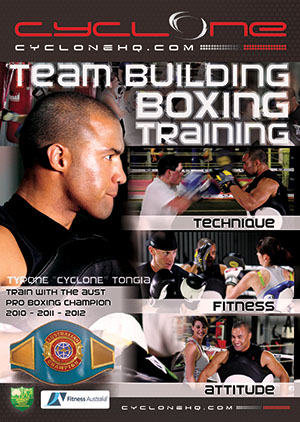
The business for Tyrone will be group fitness training, and with a huge fan base, it’s likely there’ll be plenty of demand for the only certified personal trainer in Brisbane with an Australian title.
He completed his Certificate IV and Master Trainer qualifications at the Australian Institute of Fitness in January 2010 graduating as class Champion.
While getting Cyclone Fitness off the ground takes priority at present, it’s unlikely fans of ‘The Cyclone’ are to wait long to see Tyrone back in action.
One thing I feel I must highlight is that it’s never a solo effort. Many people share the journey and I must mention a big thanks to: Ian Chapman and the VMP crew, performance coach Eric Bailey (ericbaileyglobal.com), manager Geoffrey Smith, Brad Booth, mentor Stephen Edwards, Tony Kmita and Warrick Day, John Tongia and my fiancé Nadine Kmita.”
Final Flurry...
Favourite fighter (Current, All-time and Australian): I like a lot of the top guys, both Floyd and Pac for sure. Marvin Hagler would have to be my all-time favourite, and Lenny Zapp would be my favourite Australian boxer right now.
Mayweather vs. Pacquiao: I dislike sitting on the fence, but I honestly think they’re 50/50. Sentimentally I want Pacquiao to win, but I think Mayweather will edge him out.
Klitchsko vs. Haye: I like that David Haye’s made the move from cruiserweight and progressed to where he has, but I also give Wladimir his credit for being so methodical and ruthless in his approach. I appreciate both, but I hope for the interest of world boxing that Haye wins.
The Super 6: Andre Ward was impressive against Kessler and Dirrell looked good in his loss to Froch. It’s wide open, but I like both of the Andres and also Abraham.
Pre-fight music: High energy tunes. A lot of rap, a lot of Bustra Rhymes, and metal too. I like System of a Down and that sort of heavy stuff. It’s all about getting into that energetic, clinical state of mind. I walk out to a tribal PNG drum chant.
Childhood Heroes: I actually wanted to be an NBA player, but I stopped growing when I was about 10 (laughing). My favourite player was Alonzo Mounring with the Charlotte Hornets. Alfie Langer and Mal Meninga and those sort of guys were up there too. But more than any of those guys I’d actually say that my uncle, Walter Schnaubelt, who was a full contact karate champion before moving into business, has been the biggest inspiration.